Independent Course Notes • For Educational Purposes Only


Intensive 1
Self-education • AI-assisted notesThese study notes may contain mistakes or omissions. Check Arabic examples, translations and religious references against the original lesson and reliable sources before sharing or relying on them.
Dream Arabic — Intensive 1 Day 01 — Grammar Foundations
Day 1: Arabic Word Types and Grammatical Status
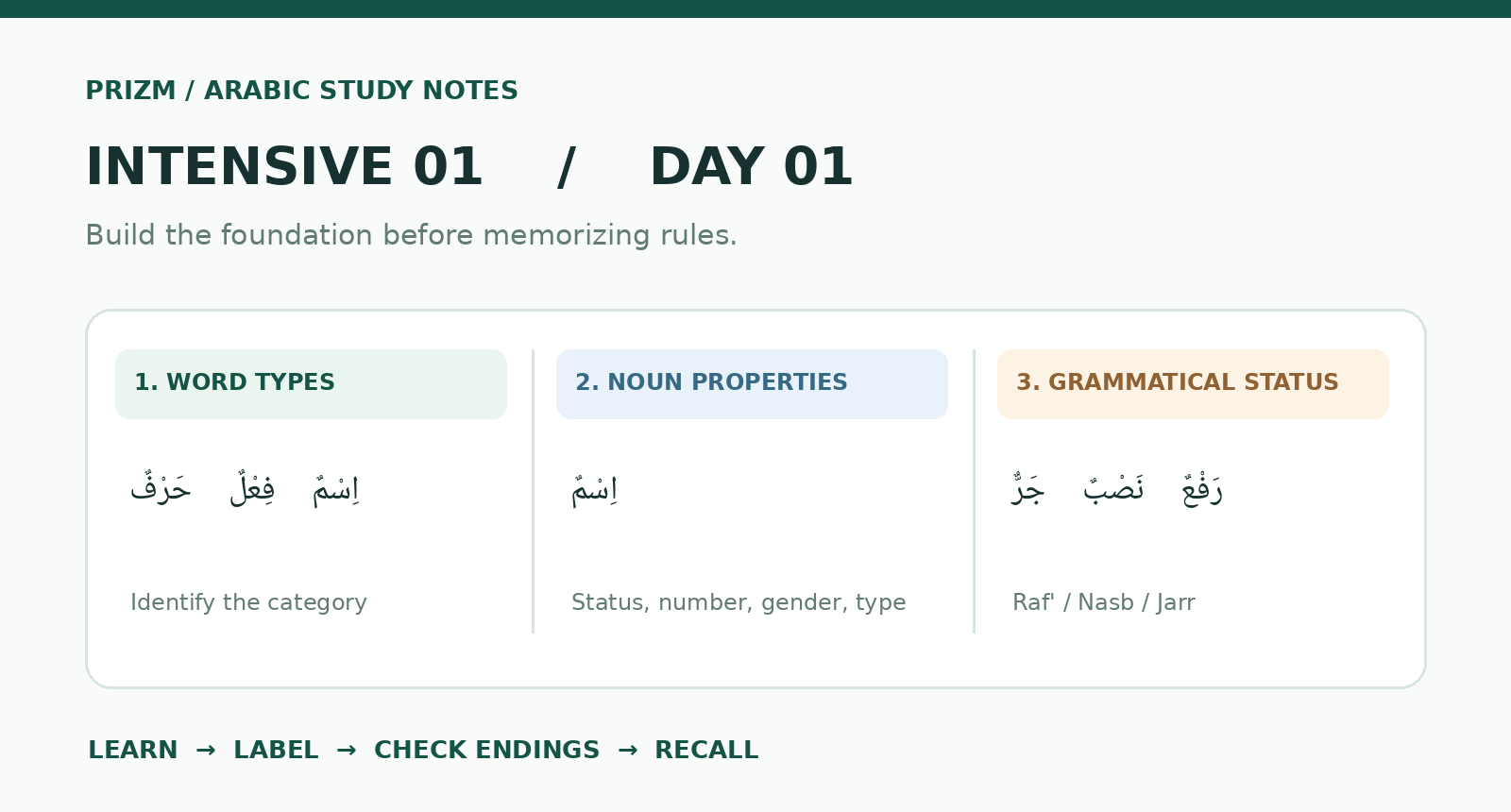
Watch original lessonOne-minute recall: Arabic words are grouped into Ism (اسم), Fi‘l (فعل), and Harf (حرف). For Ism, Day 1 introduces status: Raf‘, Nasb, and Jarr. Start by recognizing a word’s role, then inspect its ending.
About these notes: An independent, AI-assisted learning guide organized from the published Day 1 lesson outline and companion reference. It is not a complete or verified transcript of the three-hour video. Arabic examples below are study illustrations unless otherwise specified. Verify against the original before publishing.
1. Why are we studying Arabic?
The course aims to help students approach Qur'anic Arabic through grammar, not vocabulary lists alone. It distinguishes everyday spoken dialects, modern formal Arabic (fuṣḥā), and classical Arabic associated with the Qur'an. Language changes over time, so understanding older usage and context matters.
- Spoken / street Arabic: varies widely across regions and communities.
- Modern formal Arabic: used in formal writing, media, education and public communication.
- Classical / Qur'anic Arabic: the older linguistic register that this course is designed to study.
Study habit: Follow the source lesson, say answers out loud, practice actively, and revisit previous concepts. The video also encourages regular Qur'an reading to build reading fluency.
2. Every Arabic word belongs to one of three broad categories
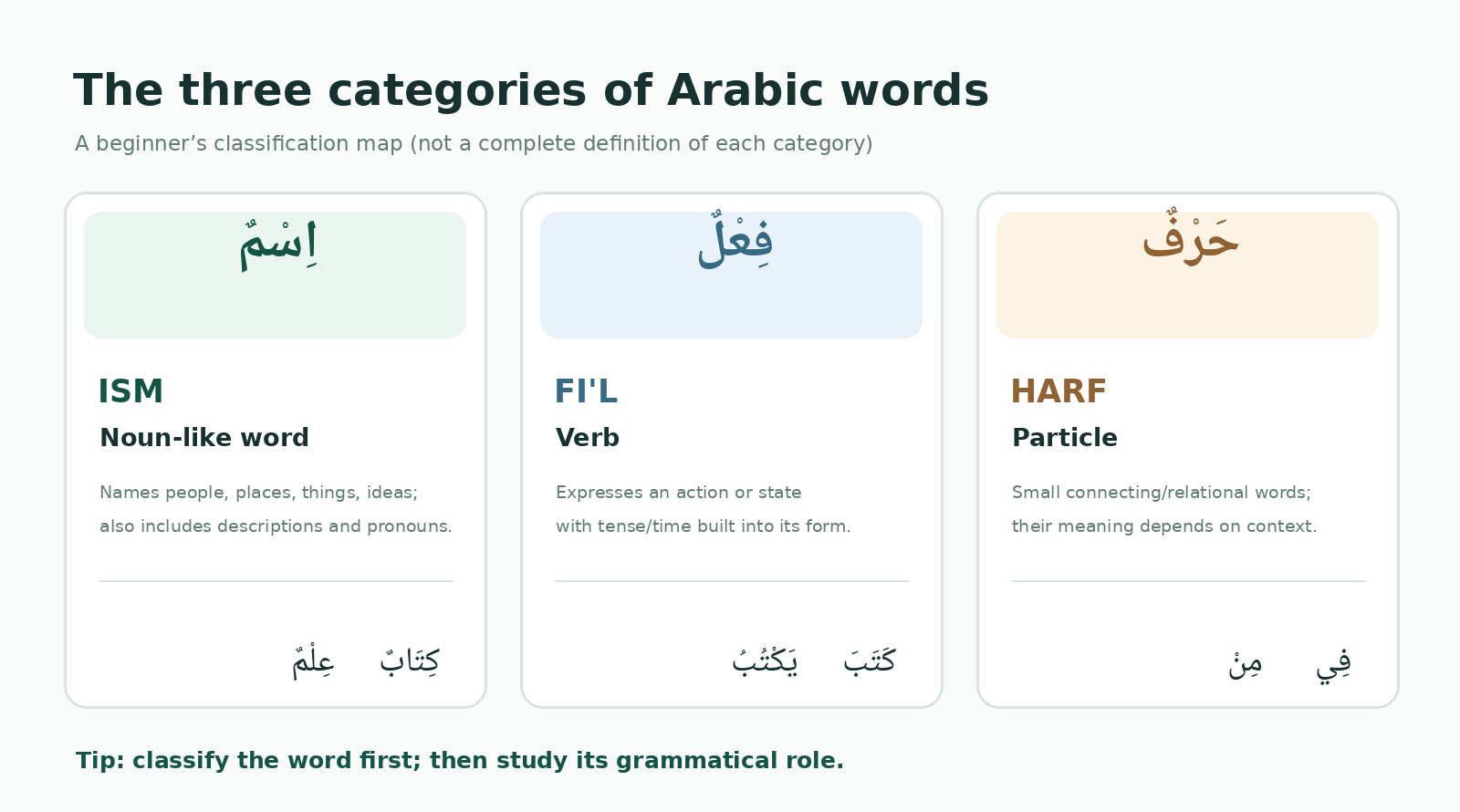
| Category | How to recognize it (beginner explanation) | Independent examples |
|---|---|---|
| Ism — اِسْمٌ | A noun-like word: a name or concept, and also many describing words and pronouns. Not a finite, tense-carrying verb. | بَيْتٌ (a house); عِلْمٌ (knowledge) |
| Fi‘l — فِعْلٌ | A verb: an action/state expressed with tense or temporal meaning in its grammatical form. | كَتَبَ (he wrote); يَكْتُبُ (he writes/is writing) |
| Harf — حَرْفٌ | A grammatical particle whose function is understood in relation to other words. | فِي (in); مِنْ (from) |
A useful distinction: action versus idea
English -ing words can confuse beginners. Compare “She is reading” (the action functions as a verb) with “Reading improves focus” (reading is used as the name of an activity). This analogy helps you understand why an Arabic Ism includes more than English “things”.
Check the Arabic: الْقِرَاءَةُ (reading, as an activity) is an Ism; يَقْرَأُ (he reads/is reading) is a Fi‘l. The word’s grammatical form matters, not just its English translation.
3. Four properties to study for an Ism
As an organizing framework, the lesson introduces four features of an Ism:
| Property | What you ask | In this course |
|---|---|---|
| Status (إِعْرَاب) | What case or grammatical status does it have? | Today's main focus |
| Number | One, two, or more than two? | Preview only |
| Gender | Grammatically masculine or feminine? | Preview only |
| Type | What kind of noun/reference is it in context? | Preview only; developed later |
4. The three statuses: Raf‘, Nasb, and Jarr
To begin, the instructor uses simple role-finding mnemonics. They help newcomers notice case relationships; they are not exhaustive Arabic grammar definitions.
| Status | Starter memory aid | Example function |
|---|---|---|
| Raf‘ — رَفْعٌ | R = the doer: who or what performs the action? | A verb's subject / fā‘il often has Raf‘. |
| Nasb — نَصْبٌ | N = an action detail: whom, what, when, how, etc. | A direct object / maf‘ūl bihi commonly has Nasb. |
| Jarr — جَرٌّ | J = think of the relationship expressed by “of”. | Common after certain prepositions and for the second noun in an iḍāfa construction. |
Accuracy alert: Not every Raf‘ word is a doer, not every Nasb word is an object or action detail, and Jarr is not limited to “of”. These are Day 1 learning shortcuts. Later lessons supply fuller rules.
Work through one sentence
قَرَأَ الطَّالِبُ كِتَابًا فِي الْمَكْتَبَةِ.
Meaning: The student read a book in the library.
| Arabic word | What it does | Status / why |
|---|---|---|
| قَرَأَ | Read (verb) | Fi‘l: not labeled with noun case |
| الطَّالِبُ | The student / doer | Raf‘, marked here by final u |
| كِتَابًا | A book / what was read | Nasb, marked here by an |
| فِي | In | Harf (preposition) |
| الْمَكْتَبَةِ | The library | Jarr, following فِي; marked by i |
5. Ending sounds: a first case-recognition shortcut
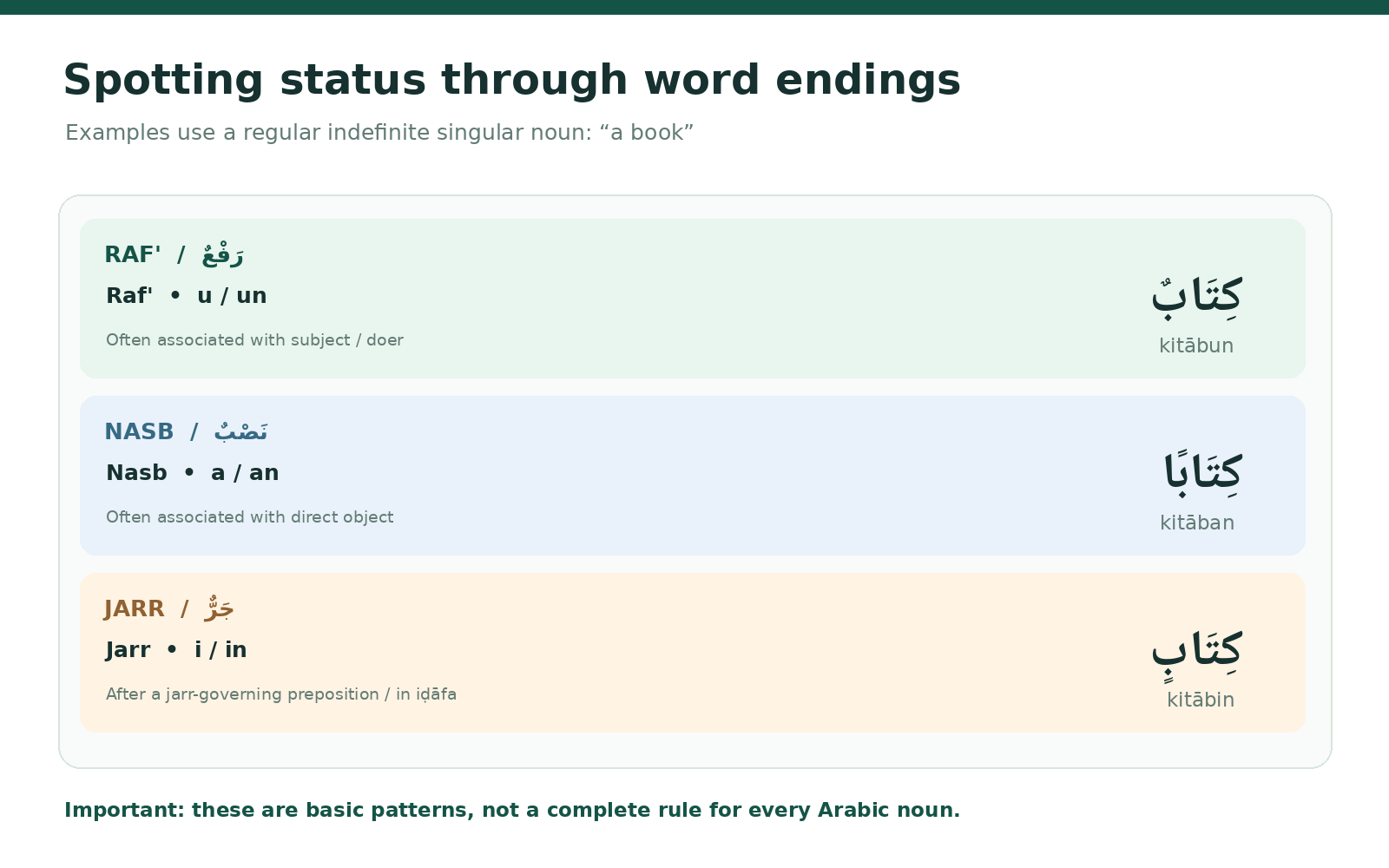
For many regular singular nouns, the final vowel can signal the noun's status. An indefinite noun may carry tanwīn, making the sound end in -un, -an, -in. A definite noun often displays -u, -a, -i instead.
| Status | Indefinite example | Approximate reading |
|---|---|---|
| Raf‘ | كِتَابٌ | kitābun |
| Nasb | كِتَابًا | kitāban |
| Jarr | كِتَابٍ | kitābin |
The case is not freely chosen: the word's grammatical relationship determines its status. Pronouncing the last short vowel may also depend on whether you are continuing speech or pausing at the word.
Preview: endings for a few other noun patterns
The companion Day 1 reference also introduces common ending combinations. Treat this as a recognition preview and practice the charts in the following classes.
| Pattern | Raf‘ | Nasb | Jarr |
|---|---|---|---|
| Sound masculine plural | مُسْلِمُونَ | مُسْلِمِينَ | مُسْلِمِينَ |
| Dual / pair | مُسْلِمَانِ | مُسْلِمَيْنِ | مُسْلِمَيْنِ |
| Sound feminine plural | مُسْلِمَاتٌ | مُسْلِمَاتٍ | مُسْلِمَاتٍ |
Practical order: Check whether you are looking at a special ending pattern (such as -ūna / -īna or -āni / -ayni) before relying on a simple u/a/i sound. Different noun forms have different ending rules.
6. Practice without looking at the chart
- Into which three groups does Arabic grammar classify words?
- Why is كَتَبَ a Fi‘l rather than an Ism?
- List the four Ism properties introduced in class.
- In فَتَحَ الْوَلَدُ الْبَابَ (The boy opened the door), identify the verb, the doer and the direct object.
- In فِي الْمَسْجِدِ, which word is in Jarr, and why?
- Match the endings -un, -an, -in to Raf‘, Nasb and Jarr.
- Which two statuses share the ending -ِينَ in the sound masculine plural?
Answer key
1. Ism, Fi‘l, Harf. 2. It is a past-tense verb, “he wrote.” 3. Status, number, gender, type.
4. فَتَحَ = verb; الْوَلَدُ = doer/Raf‘; الْبَابَ = direct object/Nasb. 5. الْمَسْجِدِ is Jarr because it follows فِي.
6. -un = Raf‘, -an = Nasb, -in = Jarr (regular indefinite singular). 7. Nasb and Jarr.
7. Your five-minute revision routine
- Minute 1: Say “Ism, Fi‘l, Harf” and define each without looking.
- Minute 2: Recall the four properties of an Ism.
- Minute 3: Recite “Raf‘ = u/un; Nasb = a/an; Jarr = i/in” and explain why this is a shortcut, not a universal rule.
- Minute 4: Label the words in the sample Arabic sentence.
- Minute 5: Answer the seven practice questions and mark anything uncertain.
References and review limitations
Original video: Bayyinah Dream Intensive 1, Day 1, taught by Ustadh Nouman Ali Khan. Companion resource directory: Aafreen Academy Arabic study resources. Official curriculum overview: Bayyinah Beginner Arabic.
Before posting publicly: Check all Arabic spellings, grammar explanations, and anything you plan to attribute directly to the teacher against the video. This page includes independently written practice sentences and is for self-education. The original course handout is not redistributed in this ZIP.
Self-education • AI-assisted notesThese study notes may contain mistakes or omissions. Check Arabic examples, translations and religious references against the original lesson and reliable sources before sharing or relying on them.
Dream Arabic — Intensive 1 Day 02 — Muslim Charts, Light/Heavy and Flexibility
Day 2: Muslim Charts, Light vs Heavy and Noun Flexibility
Watch original lessonOne-minute recall: Day 2 is about recognizing three statuses (Raf‘, Nasb, Jarr) across different noun patterns. Look for a combined ending before judging the final vowel. Then ask whether the noun is heavy or light and whether its status is fully, partly, or not visibly flexible.
Source and limitations: These are independently written, AI-assisted revision notes organized from the publicly available Dream Worldwide Day 2 study handout and video listing. They are not a complete, timestamp-verified transcript of the approximately 2-hour-45-minute lecture. The exercises and charts have been newly arranged for easier recall. Please verify the Arabic against the original lesson before publishing.
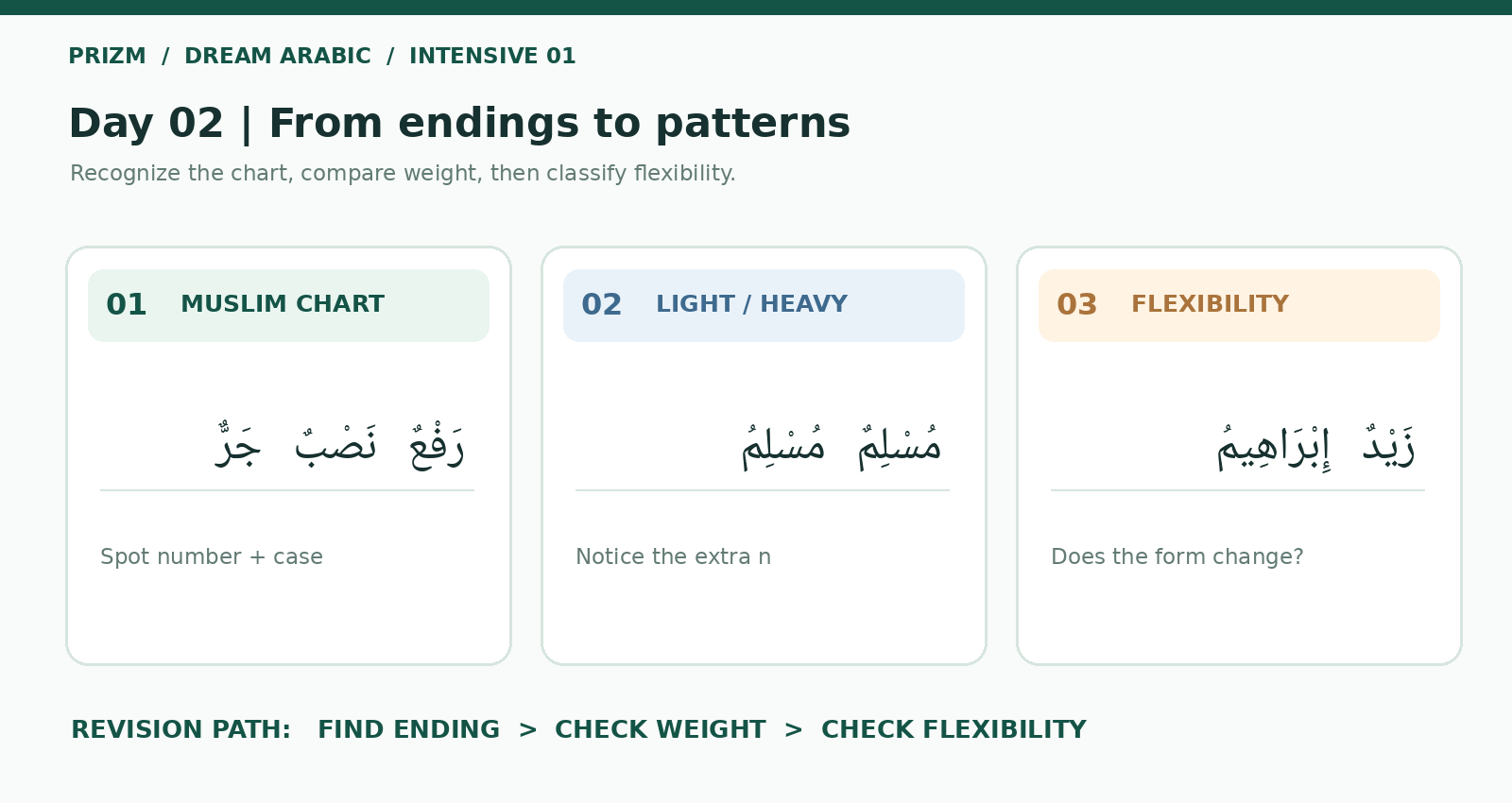
1. Start with yesterday's lesson: Raf‘, Nasb, Jarr
A noun (Ism) can carry grammatical status. In the most basic singular pattern, a change of final vowel indicates one of three statuses: Raf‘ (u/un), Nasb (a/an), and Jarr (i/in). But Arabic also uses longer endings that tell us about number and gender.
| Status | Beginner cue | Basic example |
|---|---|---|
| Raf‘ (رَفْع) | –u or –un | مُسْلِمٌ |
| Nasb (نَصْب) | –a or –an | مُسْلِمًا |
| Jarr (جَرّ) | –i or –in | مُسْلِمٍ |
Remember: English terms such as “subject,” “object,” and “after a preposition” are useful examples, not complete definitions of the three Arabic case categories. A word's syntactic function determines its status.
2. The Muslim chart: memorize the endings
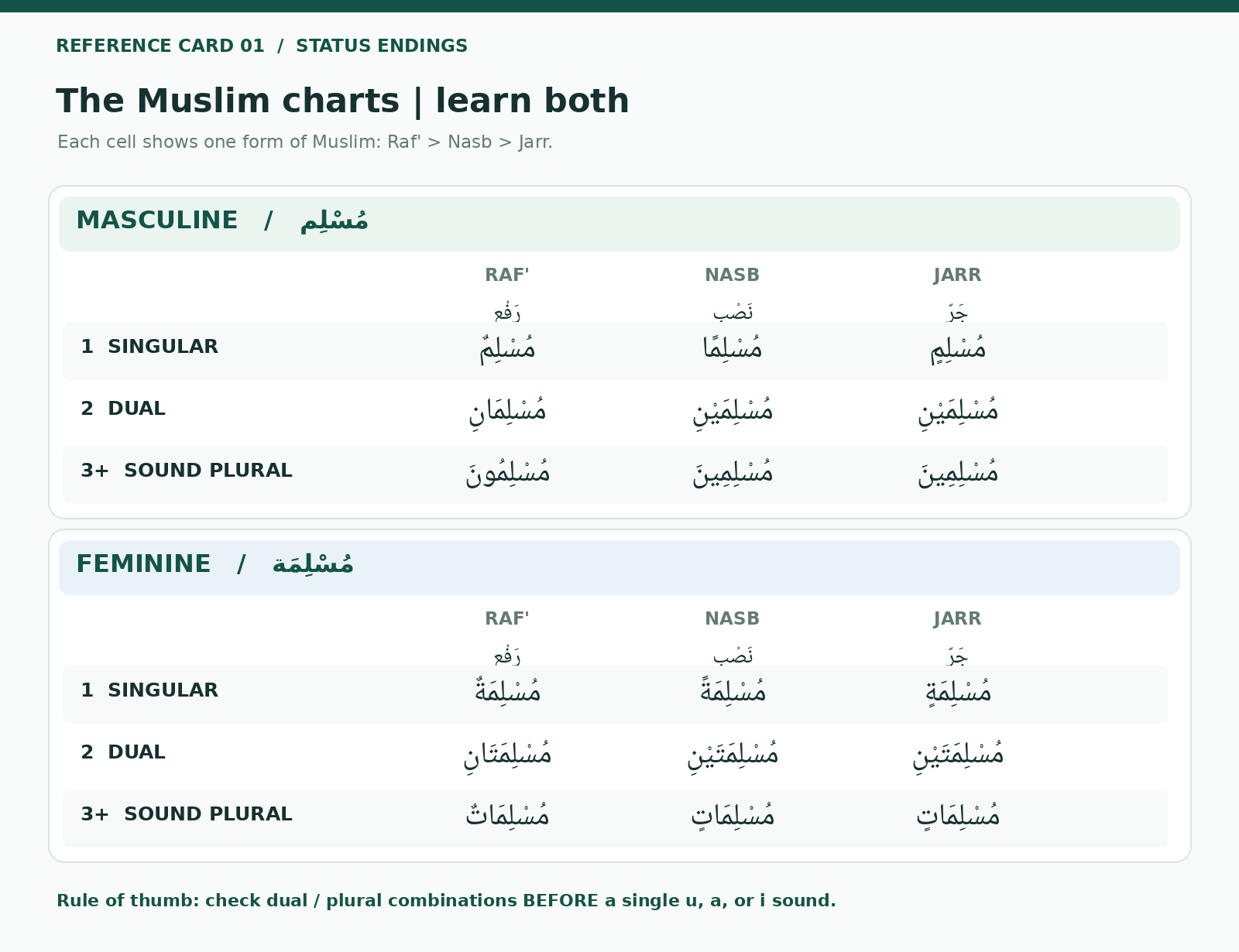
The common word مُسْلِمٌ (a Muslim) is used as a memory model. The whole form changes with singular vs dual vs plural, as well as masculine vs feminine. These examples are indefinite and show the regular/heavy paradigms used at this stage of the course.
Masculine forms
| Number / pattern | Raf‘ | Nasb | Jarr | Read the endings |
|---|---|---|---|---|
| Singular (one) | مُسْلِمٌ | مُسْلِمًا | مُسْلِمٍ | –un / –an / –in |
| Dual (two) | مُسْلِمَانِ | مُسْلِمَيْنِ | مُسْلِمَيْنِ | –āni / –ayni / –ayni |
| Sound masculine plural | مُسْلِمُونَ | مُسْلِمِينَ | مُسْلِمِينَ | –ūna / –īna / –īna |
Feminine forms
| Number / pattern | Raf‘ | Nasb | Jarr | Read the endings |
|---|---|---|---|---|
| Singular (one) | مُسْلِمَةٌ | مُسْلِمَةً | مُسْلِمَةٍ | –atun / –atan / –atin |
| Dual (two) | مُسْلِمَتَانِ | مُسْلِمَتَيْنِ | مُسْلِمَتَيْنِ | –atāni / –atayni / –atayni |
| Sound feminine plural | مُسْلِمَاتٌ | مُسْلِمَاتٍ | مُسْلِمَاتٍ | –ātun / –ātin / –ātin |
Pattern to say out loud: The pair/dual goes āni → ayni → ayni; sound masculine plural goes ūna → īna → īna; sound feminine plural goes ātun → ātin → ātin. The Nasb and Jarr forms look identical within each of these three groups; grammar is needed to distinguish them.
How to recognize status: the correct order
- Find the ending group first: is it a dual such as ـَانِ / ـَيْنِ, a masculine plural ـُونَ / ـِينَ, or a feminine plural ـَاتٌ / ـَاتٍ?
- If no special combination applies, check the final single vowel or tanwīn for the relevant declension.
- Do not force a unique answer when Nasb and Jarr have the same visible form. Use the sentence's grammar to decide.
Three mini-examples
| Arabic noun | Visible clue | What can be determined |
|---|---|---|
| مُسْلِمَانِ | –āni | Dual, Raf‘ |
| مُسْلِمِينَ | –īna | Sound masculine plural, Nasb or Jarr |
| مُسْلِمَاتٍ | –ātin | Sound feminine plural, Nasb or Jarr |
3. Heavy vs light: what happens to the extra n sound?
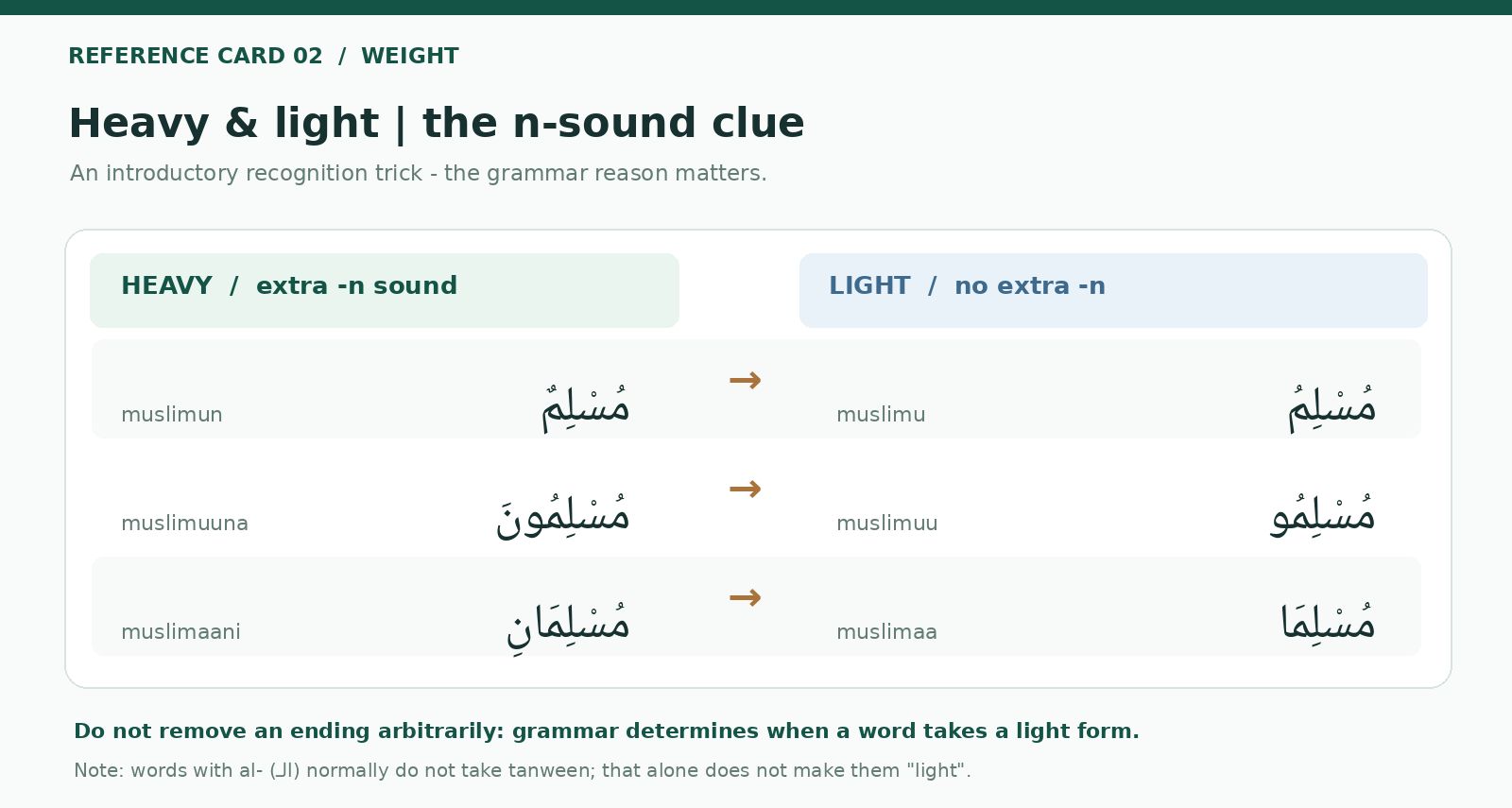
In the terminology of this course, heavy forms include an extra n sound: sometimes it appears in tanwīn (double vowel marks: –un, –an, –in), and sometimes in the final ن of the regular dual or sound masculine plural. A light form loses that extra sound in grammatical constructions that require it.
| Regular/heavy form | Light form (form only) | What disappeared |
|---|---|---|
| مُسْلِمٌ | مُسْلِمُ | The tanwīn / extra n sound |
| مُسْلِمُونَ | مُسْلِمُو | Final نَ |
| مُسْلِمَانِ | مُسْلِمَا | Final نِ |
A real grammatical context: Compare مُسْلِمُونَ (Muslims, a heavy Raf‘ form) with مُسْلِمُو الْمَدِينَةِ (“the Muslims of the city,” a construct/iḍāfa expression). In the second expression, the sound masculine plural drops its final nūn.
Common confusion: Not every noun without tanwīn is “light” in this course's sense. For example, a noun with the definite article الـ does not normally take tanwīn. Do not automatically apply the heavy/light comparison to such words. Also, never drop letters merely because you prefer a shorter form: the syntax must allow it.
4. Flexibility: do case endings change visibly?
Day 2 introduces a second question about status: Can I see the word's case change? Arabic nouns do not all behave identically. Use the three-way comparison as a first classification tool, not the whole science of Arabic declension.
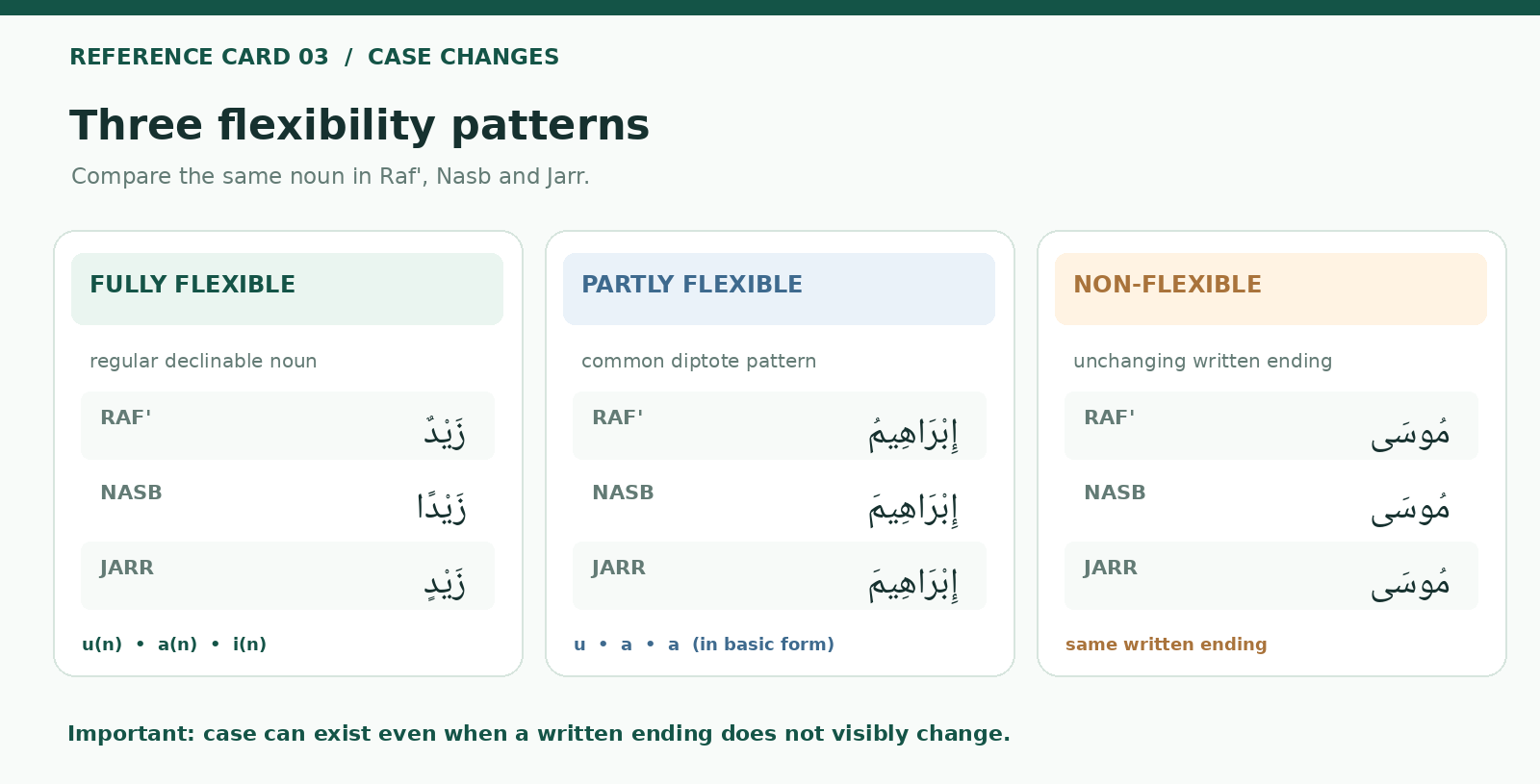
| Course category | What you will usually see | Raf‘ → Nasb → Jarr |
|---|---|---|
| Fully flexible (regular) | Three distinguishable standard indefinite case endings | زَيْدٌ / زَيْدًا / زَيْدٍ |
| Partly flexible (diptote pattern) | A typical bare indefinite diptote has u → a → a without tanwīn | إِبْرَاهِيمُ / إِبْرَاهِيمَ / إِبْرَاهِيمَ |
| Non-visibly changing (indeclinable or estimated ending) | Same visible spelling across cases; may still have a grammatical case | مُوسَى / مُوسَى / مُوسَى |
Understanding each type
- Fully flexible: A normal noun such as زَيْدٌ shows all three endings clearly: زَيْدٌ, زَيْدًا, زَيْدٍ.
- Partly flexible: Many proper names of foreign origin, such as إِبْرَاهِيمُ, show إِبْرَاهِيمَ in both Nasb and Jarr in their simple, bare forms. Certain place names also behave this way, such as مَكَّةُ → مَكَّةَ → مَكَّةَ.
- Not visibly changing: A name such as مُوسَى ends with a long alif/ā sound, so a normal short case vowel is not pronounced on its end. Its grammatical case can still be present by estimation (i‘rāb taqdīrī).
Accuracy refinement: The course's phrase “partly flexible cannot take i” is a good starter description for the bare indefinite pattern, but it is not an absolute rule. Many diptote nouns take Jarr with kasra if they have the definite article or occur as the first term of an iḍāfa. And “non-flexible” in this simplified chart can mean no visible ending change; it does not prove the noun has no grammatical case.
Foreign and place names: memorize examples, not an oversimplified test
The lesson discusses foreign names, place names, and short-name exceptions. For first-pass memory, contrast إِبْرَاهِيمُ (typically diptote) with نُوحٌ (fully declined in ordinary usage). Many diptotes require more than one grammatical condition; do not use a universal “all foreign names” or “all three-letter names” rule without consulting a grammar reference.
5. Recognize grammar in complete sentences
Independent practice examples below show why the same noun may have different endings. They are illustrations added for revision, not verbatim quotes from the lecture.
| Sentence | Meaning | Why this ending? |
|---|---|---|
| جَاءَ زَيْدٌ. | Zayd came. | Zayd is the doer: Raf‘, ending –un. |
| رَأَيْتُ زَيْدًا. | I saw Zayd. | Zayd is the object: Nasb, ending –an. |
| مَرَرْتُ بِزَيْدٍ. | I passed by Zayd. | After the preposition bi-: Jarr, ending –in. |
| جَاءَ إِبْرَاهِيمُ. | Ibrahim came. | Typical diptote proper noun: Raf‘ with –u. |
| مَرَرْتُ بِإِبْرَاهِيمَ. | I passed by Ibrahim. | Simple diptote form in Jarr has –a, not –i. |
6. Qur'anic practice: Surah Al-Qāri‘ah
The Day 2 handout refers to an exercise identifying the grammatical status of words from Surah Al-Qāri‘ah (101). To practice on a small, clearly attributed passage, look at the two verses below. The annotations focus on the basic status of selected Ism words only.
يَوْمَ يَكُونُ النَّاسُ كَالْفَرَاشِ الْمَبْثُوثِ
101:4 — “The Day when people will be like scattered moths” (a brief study rendering).
وَتَكُونُ الْجِبَالُ كَالْعِهْنِ الْمَنْفُوشِ
101:5 — “And the mountains will be like fluffed wool” (brief study rendering).
| Word | Status | Reason (introductory) |
|---|---|---|
| يَوْمَ | Nasb | Time expression / ẓarf (adverbial of time). |
| النَّاسُ | Raf‘ | Noun governed by kāna-type verb {A("يَكُونُ")}. |
| الْفَرَاشِ | Jarr | Following comparison particle/preposition kāf (كَـ). |
| الْمَبْثُوثِ | Jarr | Adjective agrees in case with {A("الْفَرَاشِ")}. |
| الْجِبَالُ | Raf‘ | Noun governed by {A("تَكُونُ")}. |
| الْعِهْنِ | Jarr | Following the comparison kāf. |
| الْمَنْفُوشِ | Jarr | Adjective agreeing with {A("الْعِهْنِ")}. |
Qur'an accuracy: Check the exact Arabic spelling, verse text, translation, and grammatical annotation against a verified muṣḥaf and trusted tafsīr/grammar reference before public posting. This section is a small, self-study case exercise—not tafsīr and not a complete grammatical analysis.
7. Test yourself without looking
- What is the basic order of statuses in the chart?
- For the masculine dual, fill in: Raf‘ مُسْلِمَانِ; Nasb ______; Jarr ______.
- In the sound masculine plural, which endings signal Raf‘ and which are ambiguous between Nasb and Jarr?
- Why might مُسْلِمَاتٍ be either Nasb or Jarr?
- Which three endings occur in the indefinite singular masculine pattern?
- What is the practical meaning of “heavy” in the class chart?
- What happens to مُسْلِمُونَ in the construct expression “Muslims of the city”?
- Does adding الـ and removing tanwīn automatically mean “light” in this course's terminology?
- Which is a typical diptote: زَيْدٌ or إِبْرَاهِيمُ?
- How does إِبْرَاهِيمُ change in its bare Jarr form?
- Does مُوسَى having the same written ending imply it has no grammatical case?
- In مَرَرْتُ بِزَيْدٍ, identify the word in Jarr and the clue.
Answer key
1. Raf‘, Nasb, Jarr. 2. مُسْلِمَيْنِ for both Nasb and Jarr. 3. ـُونَ is Raf‘; ـِينَ is Nasb or Jarr. 4. In this pattern Nasb and Jarr are identical in form.
5. –un, –an, –in. 6. A form with the extra n sound (tanwīn or final nūn in certain combinations). 7. Final nūn disappears: مُسْلِمُو الْمَدِينَةِ. 8. No.
9. إِبْرَاهِيمُ. 10. إِبْرَاهِيمَ (typical bare diptote Jarr). 11. No—case may be estimated, not visibly marked. 12. زَيْدٍ because it follows بِـ.
8. A repeatable ten-minute revision plan
- Minutes 1–3: Draw the masculine table from memory; then check every entry against the chart.
- Minutes 4–6: Draw the feminine table, especially the dual and sound feminine plural forms.
- Minutes 7–8: Say the two meanings of “n ending”: tanwīn and extra nūn in a dual/plural pattern; name one valid light-form context.
- Minutes 9–10: Compare Zayd, Ibrahim, and Musa in Raf‘/Nasb/Jarr. Return to the exercise for every wrong answer.
9. Original sources, attribution, and fact-checking
- Original class: Dream Intensive 1 Day 2 — Nouman Ali Khan (YouTube).
- Course Day 2 notes: Dream Worldwide FundamentalsDay2 (official companion PDF); linked for verification, not reproduced in this pack.
- Study sequence: Aafreen Academy study schedule (Week 2: video, workbook practice and memorizing page 6).
- Course resource directory: Bayyinah Dream Arabic resources.
Required editorial review: Intended for private revision and self-education. Content is AI-assisted and can contain errors or oversimplifications. Before publishing on prizm.pk, review it against the class and an authoritative Arabic grammar reference. No official transcript, workbook pages, or teacher-owned figures have been republished inside this ZIP; all diagrams and explanations here were created for this study pack.